OUR NETWORK:TiVo Community Explore3DTV TechLore MyDigitalEntertainer See all... About UsAdvertiseContact Us

Upgrading the HP EX485/487 MediaSmart Server Processor, Removing the Smoke and Mirrors (Page 1 of 5)

Purpose:

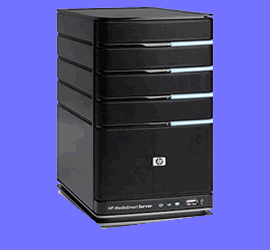
This article is a culmination of the work of many on this and other web sites.  The sole purpose is to clearly define and outline the steps necessary to modify your HP EX485/487 MediaSmart Server (or MSS) from a single core Intel Celeron 440 to the more powerful Intel Dual Core. It will present various options for the MSS user and provide a one stop resource for the complete upgrade process.  Choosing a CPU, performance gains/benchmarks, power consumption temperature and memory upgrades are discussed as well. 

I will try to sort through some of the technical jargon and issues that can make this process complicated.  While the scope of this article will toward the E5200 CPU that has been extensively tested, it will also list other CPU designations reported to work for your consideration. 

Depending on your level of expertise you might find some topics interesting or boring, but they're listed here regardless of your abilities.  Some useful tips have been included and some very useful links have been placed in the reference sections at the end of the article.


Warning and Disclaimer:

Read this document completely before diving in! The author of the article assumes no responsibility for "bricking" "smoking" or voiding the warranty of your MSS as a result of your action.  Safe to say, if you take the cover off you have probably voided the warranty.   If you do not feel comfortable with disassembly, modifications, handling electronics parts, software configuration or are not familiar with electrostatic procedures, you should stop here and get help

OK, now that we have satisfied the lawyers out there lets move on...


Background of the Media Smart Server:

The HP MediaSmart Server EX48X series (EX485 & EX487) are the second generation servers in the MediaSmart Server line, released as the successor to the EX470 and EX475. The EX485/7 come provisioned with an Intel Celeron 440, single-core 2Ghz processor. This was an upgrade over the less powerful AMD cores used in the 470 series.

The Celeron 440 provides reasonable performance for basic operations, WHS administrations, backups, photo management and file functions on your network. Unfortunately, when you ask it to run other add-ins, such as CPU intensive audio and video streaming/compression, it runs out of steam quickly. This results in dropouts, pauses and other issues.

What's the Solution?

There is no total solution because of the limitation of the HP hardware and intent of design. Some of the limits are: a minimal power supply, passive CPU cooling with low air circulation, limited case size, and an unforgiving proprietary motherboard that is nearly impossible to buy on the open market with no recovery features.  While we can't solve all the problems we can improve performance to a more acceptable level and limit the risks of the modification.

Cost:

How much will this cost me and is it worth it?  Obviously this is a major consideration unless you're a hobbyist or just love hacking.  It does not make much sense dumping a ton of money into a platform that, in the end, won't perform as you expect it to.  Sometimes we just have to admit that no matter how hard we try we just can't make a pig fly. This is the conclusion that some have come to. 

If you are thinking this upgrade will make the 485 a "barn-blazing video-eating audio-blasting end-all" platform, forget it.  What it will do, however, is give you a 100% performance increase over the Celeron 440, and can be done for around $60.00.  Granted, you could spend a great deal more, but how much you want to spend and how deep you go is up to you.  

What's next? Choosing a Processor:

This depends on the route you choose and the processor you select. For those who want transparency and minimal work should buy an Intel Dual Core E5200 processor with sSpec of SLAY7 or QFHQ. This sSpec specific core will provide the all around best bang for the buck with the least amount of implementation work or operational issues. The E5200's are readily available both new and used from many sources.  E5200 processors are also used in the third generation of the MediaSmart Server. 

Let's talk a little about what this sSpec code is all about. (I will cover the E5200 sSpec SLB9T later in the article).

What is an sSpec?

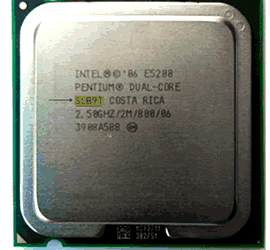
The sSpec number is also known as the specification number and stepping code. It contains 5 characters  (SLAY7, for example) stamped on top of the processor and printed on the box to identify it.

Do Intel processors of the same model have the same sSpec?

Not necessarily. The same processor number can have many different sSpecs codes because when a processor stepping change occurs, a new sSpec is generated for that stepping. It is also true that the same stepping level can also have more than one sSpec associated with it.

What is a processor stepping?

It is the revision level of the CPU silicon. The stepping version can be changed for a number of reasons. These can be to fix some errata, raise the performance/ clock speed, modify die sizes, or to reduce power consumption, and can include micro code changes or updates.  Generally, a higher stepping version is better, but not in the case of compatibility with the EX485.

When stepping version change, what is the naming convention?

Each stepping gets a different name. The usual naming convention is to change the letter of a stepping on each full-layer stepping and change the number of a stepping on the metal-layer stepping. As an example, the first full-layer stepping from A0 would typically be B0, while the first metal-layer stepping from A0 would be A1. In the case of our target processor, the E5200, there are three sSpec versions using 2 stepping models, M0 and R0.  M0 is the most compatible for our MediaSmart Server application and the desired choice.

Where can the sSpec value be found?

You can find sSpec value by looking at the markings on the processor top-side (see Figure 1), or on the bar code label on the side of the processor box (Figure 2).  Here's an example of each location.

Why is all this stuff important?

This information is important because it is necessary to know how to identify and select sSpec for a given CPU, and also to select the one that will work best for our application. Before you agree to purchase any CPU be sure the seller can provide the sSpec code. 

Which Intel CPU should I use and how this choice affects BIOS settings:

Many have mentioned having some success with other dual-core Celeron, Pentium, and Xeon units. Some of CPU's reported to work are the: E3300, E3400, E4400, E6300, E6420, E8200, L3110 Xeon's and a few others. Some of these processors have higher clock rates, larger cache sizes, and advanced technologies, some of which will be taken advantage of. 

For a CPU to be utilized for optimum performance, the motherboard and chipset must contain the information to accommodate the processors abilities and operating parameters.  This is partly done in the system BIOS.

BIOS (Basic Input/Output System) is a set of instructions and parameters that CPU uses to bootstrap or begin startup.  The BIOS also provides the necessary code to hand off the boot process to the boot loader on the hard drive and boot the operating system. The BIOS for the 485 is contained on a single flash chip on the motherboard. 

As you can see, the BIOS is a key consideration. Values specified in the BIOS that do not fully match the CPU can easily cause operational inconsistencies.

The Intel E5200 appears to be the upgrade processor of choice.  This article will focus on the use of this core.  This is not to say that the E5200 is the best selection, but it does have a number of features that put it high on the list. 

First, it is the same processor that HP is using in the third generation EX495. Second, it is cheap (approx $60.00) and easy to find on the open market. Third, it provides a noticeable improvement over the stock Celeron 440 core.  And finally, it can be implemented with no adverse operational issues.

>> Next page:  The Intel E5200 vs. Celeron 440 Comparison >>

Page 1 2 3 4 5 Next »


Please log in or register to participate in this community!

Log In

Remember

Not a member? Sign up!

Did you forget your password?

close this window
close this window