Converting and Streaming Home Movies with the HP MediaSmart Server (Page 1 of 4)
Categories: Setup and Installation Smartphones and Personal Media Devices Digital Media Receivers
Even though the technologies and methods have changed considerably in the last 50 years, the general principal behind home movie making has pretty much remained the same. The goal: capture, preserve, and enjoy precious moments and memories again. How we achieve those goals, however, are being once again revolutionized in response to the biggest problems with the home movie experience: cost, accessibility, and convenience.
The solution: get that video into the PC.
Many of the technological advances in camcorders are in direct response the complaints of cost and convenience. Hard disc and flash memory are being heavily favored over consumable physical mediums like tapes and optical discs. No longer will you be relying on these "hard copies" to store these precious memories, nor will you be popping discs into machines designed to play back the information. Thankfully, the new digital technologies in home movie camcorders is making it fast and easy to get video into your computer.
Accessibility and convenience are being addressed by the rise of digital media streaming and the home network. The computer age in home movie making is here; home movies are now files on your PC. This means you'll be streaming your home movies to your TV over a network instead of using DVDs, Blu-Ray discs, or worse, connecting your camcorder to your TV to play back 8mm, VHS/C, and Mini-DV tapes (gasp!).
If you're here, you've already decided that you want a better way; to make your home movies more accessible and reduce cost on consumables. But as you've discovered, there's a catch to all this convenience. If you're playing catch up, and/or don't have the latest and greatest technology for capturing home videos, getting all your home movies in a format that can be streamed is not entirely intuitive.
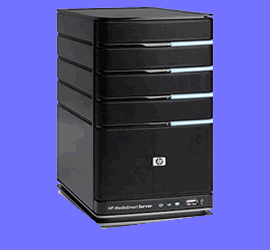
That's where HP's MediaSmart Server comes in. The MediaSmart Server, running Windows Home Server, is an excellent device to use as the central hub of your home movie experience. While any Home Server can handle the storage and streaming aspects just fine, only HP's MediaSmart Server includes some useful programs, like the HP Video Converter, to help make it easier for you to get those pesky home movie files in a format ready to stream to your TV or handheld.
The HP Video Converter
The HP Video Converter, currently available to EX-485 and EX-487 users running the 2.5 update, can simplify the process of getting your home movies into a format suitable for streaming to devices around the home, as well as viewing on PCs and compatible portable devices. That format is called MP4 AVC, or otherwise commonly referred to as h.264. This format for video is quickly becoming the universal, dominant format for media portability and streaming. As of Windows Home Server Power Pack 2, Windows Media Connect directly supports h.264 files with the MP4 extension.
Depending on your configuration settings, the HP Video Converter can create a full quality and mobile quality version of a given video file. The original is not overwritten; converted files are stored in a new "Converted Videos" folder, where inside you'll find one folder for full quality encodes (FQ) and mobile quality encodes (MQ).
The goal here is to get your home movies into this format, but first we need to do a little set up in the Home Server Console.
Creating Conversion Folders
By default, the HP Video Converter monitors your Videos folder for new content to convert into MP4 files. If you want a full and mobile quality version of every video you have, then you'll be fine with the defaults. Remember, because the original file is not overwritten, you can start chewing through disk space pretty quickly if you create full and mobile quality versions of every file. You can delete the original if it's no longer necessary, but if you're anything like me, the videos folder gets crammed full. It gets tough to find a particular video after a while.
Personally, I like a bit more control over which videos get converted in the first place. Since this will be used for home movies as well as other videos, I know I'll never want to access remotely, are already in a format that really doesn't need conversion, or that I'll never want to stream to a TV. So, I set up a "To Convert" shared folder and use that for any videos that I need converted.
If you'd like this flexibility, add a new shared folder from the Home Server Console. Click Shared Folders, then Add in the left corner.
If not, stick with the defaults. You can always change this around later if you change your mind.
Compatible Formats
The HP Video doesn't handle every possible format in the world. So if you intend to use the HP Video Converter to create streaming friendly files from your home movies, you'll need to get it in one of these formats.
| AVI | DivX 4,5,6 with MP3 or AAC audio XviD with MP3 or AAC MJPEG with ADPCM or PCM |
| WMV | WMV or VC1 with WMA audio |
| MPG / VOB | MPEG-1 or 2 with MP2, PCM, or AC3 audio |
| MOV | MJPEG-A, B with PCM audio |
| MP4 / M4V | MPEG 4 with AAC |
| DVR-MS | MPEG-2 with AC3 audio |
In other testing, I've found other configurations that also work. For example, I didn't have any problem encoding an XviD file with AC3 audio. So even if your video format isn't specifically listed, it's always worth a try.
HD camcorders, regardless of what medium the video resides, can't be converted with the HP Video Converter. See more in "Limitations and Important Notes" below.
Know that you know the process, it's time to get your movies into your computer, and converted with HP Video Converter.


RSS